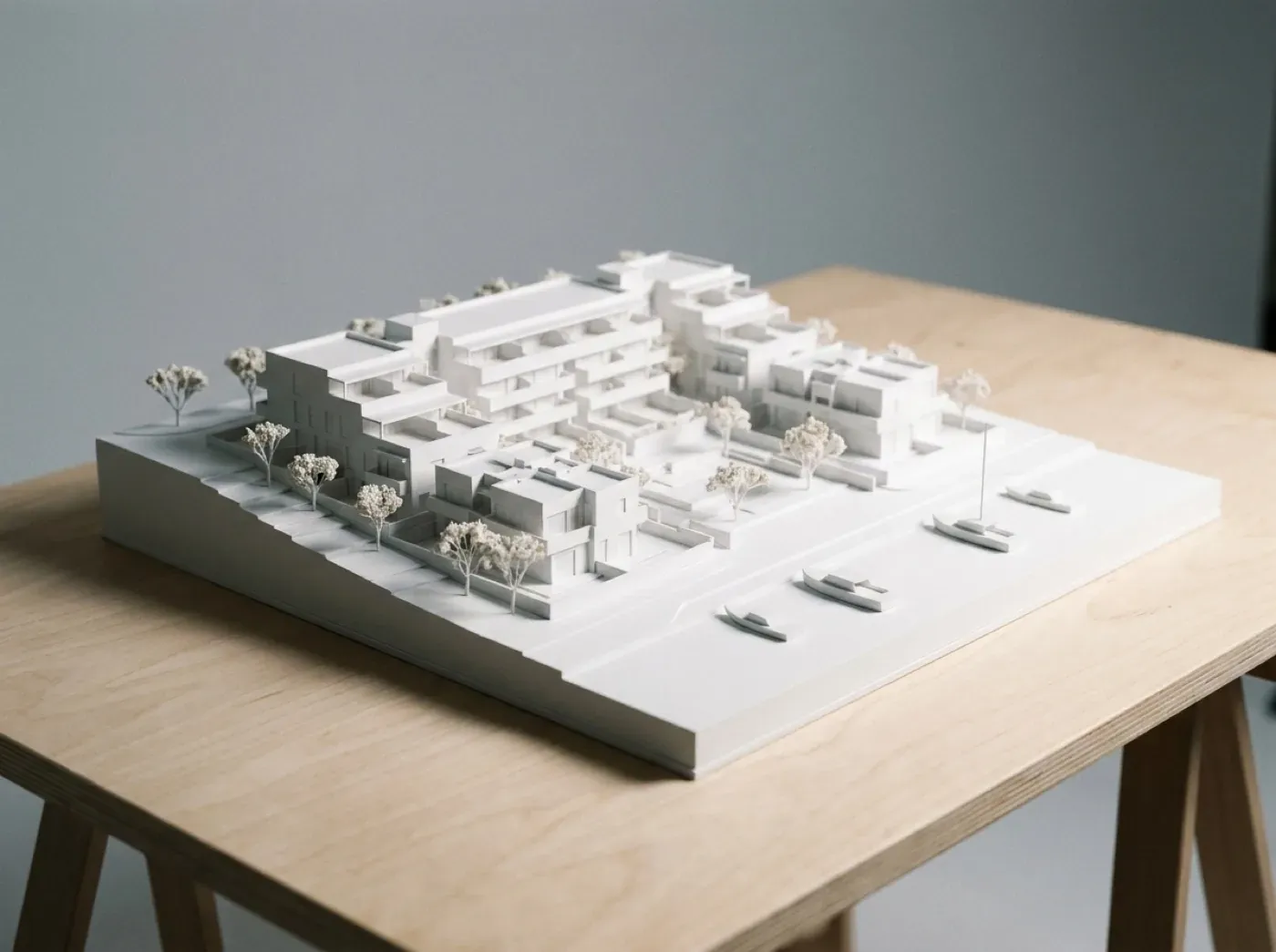
What a Presale Gallery Has to Answer Before a Buyer Will Call
A buyer cannot walk a building that does not exist, so the gallery has to carry the visit.
 Mikita Dasiukou Founder, Untrue Studio · 5 min read

Picture a couple driving past your fenced lot on a Saturday. There is a banner, a rendering and a web address. That evening they look it up from the couch.
Then the questions start. Does the kitchen get morning light? Will our table fit in the dining area? Is the end unit still available? At a finished building, they would walk through and ask someone. Here there is nothing to walk through and, at that hour, no one to ask.
That is the job of a presale gallery. It is not a brochure with better pictures. It stands in for a visit that cannot happen yet, and it has to do that without a person in the room.
The gallery is doing an agent’s job
A good sales agent does more than show a home. They listen for the question behind the question, and they answer in a useful order. Does this place suit our life? Will our things fit? Can we afford it? Is it still there? Can we trust the people building it?
Presale material often answers a different set of questions. It tells the buyer that the building is beautiful, that the location is desirable and that the lifestyle is enviable. All of that may be true. None of it tells them where the sofa goes.
A beautiful gallery that cannot answer a practical question sends the buyer to a form. Some of them will fill it in. Some of them will close the tab.
So the useful place to start is not your image list. It is the list of questions your buyer would ask if they were standing in the home with an agent beside them.
The ten-question test
Open your gallery on a phone and try to answer these without help. Do not use your own knowledge of the project. Ten questions will not cover every project, so change any that do not fit yours.
- Where exactly is it, and what is next to it?
- Which way does this home face, and where does the light fall during the day?
- How big are the rooms, in a way I can picture?
- Where does my furniture go?
- What is included, and what are the finishes?
- Where do I park, and how do I get from the car to the front door?
- What will I actually see from the windows?
- Roughly what does it cost?
- Is the home I like still available?
- When could I move in, and who do I ask if I have a question?
Mark each one in one of three ways: answered, partly answered, or sent to a form or a phone call.
Then ask someone who has not seen the project to do the same, and watch them without helping. You already know the answers, so you are a generous judge. A person who has never seen the site plan will show you which of your answers only make sense to someone who has.
Read the results honestly
Every question that ends in a form or a phone call is a place where a buyer may simply leave. That does not mean every one of them is a failure.
Some questions deserve a conversation. Financing, timing for a specific home and a request to hold one are all better handled by a person. A form is the right answer when a person really should respond. It is the wrong answer when a floor plan could have done the job.
Partly answered questions are usually the cheapest to fix. A plan exists but is too small to read on a phone. A view image exists but no one can tell which homes it belongs to. A finish is shown but not labeled as standard or upgrade. These gaps need editing, not new production.
Match the material to the question
Once you can see the gaps, each one points to a kind of material. This is a starting point, not a rule.
| The buyer is asking | What usually answers it |
|---|---|
| Is this place for me? | Exterior image, neighborhood context, site map |
| Which home suits us? | Plan comparison, unit locations, orientation |
| Will our life fit in here? | Marketing floor plans with furniture at true scale |
| How does it feel to be inside? | Interior stills and a 360° tour |
| What does it look like up close? | Finish images with clear standard and upgrade labels |
| Can we have it? | Live availability and pricing cues |
| Who do we talk to? | A short form and a named response time |
Notice how little of that table a hero rendering covers. It is the image that earned the click, and it has already done its job. The next note looks at that image and how to decide what each picture you commission is for.
Notice also where a tour sits. It is very good at one row. It shows how a home feels and how the rooms connect, in a way a still cannot. It does not tell the buyer whether the home is available or whether their dining table fits. A tour earns its budget when it is part of an answer, not when it is the whole gallery.
What the test will not tell you
The test is a first pass, and it has limits. It will not tell you whether your design is right for the market, or whether your pricing is. It cannot tell you whether the images are good. A gallery can answer all ten questions and still look careless.
It will also not make an image true. Every answer in the gallery is something a buyer may rely on later, which is why what a rendering is allowed to promise matters as much as what it shows.
What the test does give you is a shorter and more honest list of work. Instead of asking what else the gallery could have, you can ask which question it still cannot answer. That list is your next shot list.
Run it this week
It takes one phone, one colleague who does not know the project and the ten questions above. Do it before you commission anything else. If your gallery does not exist yet, run the test on the material you do have, including the website, the brochure and whatever your sales team sends by email.
Whichever questions fail first are the ones your next dollar should answer.